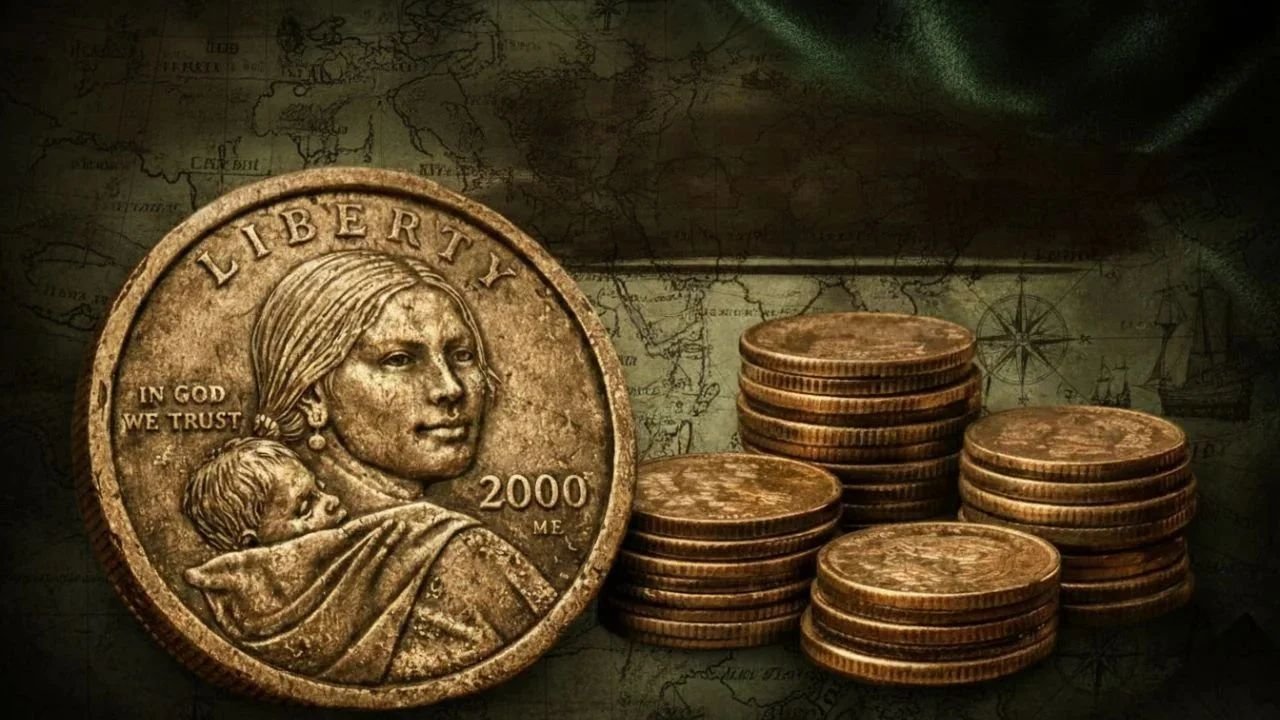
The Sacagawea dollar has evolved from a widely circulated modern coin into a serious topic of discussion among advanced collectors and investors. First released in 2000, the series honors Sacagawea, the Shoshone woman who guided the Lewis and Clark expedition across the American West.
For years, most Sacagawea dollars traded at face value. Yet in 2026, renewed attention followed reports of an ultra-rare example achieving a staggering $2.1 million at auction. While that figure represents an extraordinary outlier tied to rarity and pristine condition, it underscores a crucial truth in numismatics: even modern coins can reach elite valuations when scarcity, condition, and narrative align.

This guide explains what truly drives value in Sacagawea dollars—and how to determine whether a coin in your possession may carry premium potential.
Design, Composition, and Historical Significance
The obverse portrait of Sacagawea was created by artist Glenna Goodacre. It depicts her carrying her infant son, Jean Baptiste, symbolizing guidance and resilience. The original reverse featured a soaring eagle, representing peace and freedom.
Beginning in 2009, the reverse design transitioned into the Native American $1 Coin Program, introducing annually changing themes that celebrate Native American contributions to U.S. history.
Despite its golden appearance, the coin contains no actual gold. It is composed of a copper core bonded to manganese-brass outer layers, which provide durability and its distinctive tone.
Key specifications include:
- First year of issue: 2000
- Composition: Copper core with manganese-brass cladding
- Edge: Plain on early issues; later Native American dollars feature edge lettering
- Mint facilities: Philadelphia Mint (“P”), Denver Mint (“D”), and San Francisco Mint (“S”)
While billions have been minted, true scarcity exists within specific varieties and errors—not the series as a whole.
How a Sacagawea Dollar Reaches $2.1 Million
Multi-million-dollar coins achieve such valuations through a rare combination of factors. Three pillars typically define elite pricing.
1. Major Mint Errors
The most valuable Sacagawea dollars are dramatic minting anomalies. These may include:
- Struck on the wrong planchet (such as a quarter or experimental blank)
- Significant off-center strikes
- Double die errors with clearly visible design duplication
- Transitional or prototype strikes
When an error is both visually dramatic and extremely rare—especially if it is one-of-a-kind—collector demand intensifies rapidly. Competitive bidding among advanced buyers can drive prices into seven-figure territory.
2. Exceptional Condition
Condition is often the decisive factor in modern coin valuation. Coins graded MS67 or higher on the 70-point scale can command exponential premiums over circulated examples.
Certification by respected grading authorities such as Professional Coin Grading Service and Numismatic Guaranty Company validates authenticity and assigns an official grade.
Original luster, sharp strike detail, and minimal surface marks are essential. Even a rare mint error must be preserved in near-perfect condition to achieve record-level pricing.
3. Narrative and Market Psychology
Collectors value story as much as scarcity. A coin tied to a documented production anomaly, early release controversy, or historic milestone carries heightened appeal.
In high-end numismatics, rarity plus narrative often equals extraordinary valuation.
Notable Sacagawea Dollar Varieties
While million-dollar examples are exceptionally rare, several documented varieties remain highly collectible.
The 2000 “Cheerios” Dollar
In early 2000, a limited number of Sacagawea dollars were distributed through a cereal promotion. These coins featured enhanced tail feather detailing on the reverse eagle, distinguishing them from standard circulation strikes.
Authenticated examples of this variety, especially in top Mint State grades, can command substantial premiums.
High-Grade Business Strikes
Even standard Philadelphia and Denver issues can become valuable in elite grades. Registry-set competition has elevated demand for coins certified at MS67 and above, particularly when population reports show limited availability.
Proof and Burnished Issues
Proof coins struck at the San Francisco Mint feature mirrored surfaces and frosted devices. High-grade proof examples—especially those graded PR70—remain desirable among modern specialists.
Burnished uncirculated versions also attract collectors seeking pristine finishes with limited mintages.
How to Evaluate Your Sacagawea Dollar
If you are reviewing coins from circulation or stored collections, take a structured approach.
Step 1: Inspect Under Magnification
Use strong lighting and magnification to check for:
- Doubling in lettering or date
- Off-center alignment
- Unusual thickness or weight
- Edge anomalies
Any deviation from the standard design may warrant further research.
Step 2: Verify Year and Mint Mark
Certain early years, particularly 2000 issues, have known varieties. Later Native American series coins include edge lettering, which should be examined for errors such as missing inscriptions or inverted text.
Step 3: Compare With Verified References
Consult trusted numismatic databases and certified auction archives. Visual comparison is essential when confirming varieties.
Step 4: Seek Professional Certification
If your coin appears unusual or exceptionally well preserved, professional authentication is critical. Certification enhances market credibility and resale liquidity.
Realistic Market Expectations
Perspective is essential. The vast majority of Sacagawea dollars remain worth exactly one dollar.
The $2.1 million headline reflects a rare convergence of uniqueness, condition, and intense collector competition. Investors should focus on documented varieties and certified high-grade examples rather than speculative assumptions.
Modern coin investing rewards patience, research, and disciplined selection.
Investment Outlook for Modern U.S. Coins
Modern U.S. coinage has gained increasing respect among high-net-worth collectors. Transparent grading standards, global auction platforms, and registry competition have brought new visibility to top-condition pieces.
The Sacagawea dollar benefits from:
- Strong cultural relevance
- Ongoing Native American reverse themes
- Broad public recognition
- Accessibility for entry-level collectors
For diversified investors, rare certified coins can provide tangible asset exposure beyond traditional markets. However, expertise and long-term perspective remain vital.
Final Perspective
The Sacagawea dollar’s transformation from everyday currency to headline-making collectible illustrates the power of rarity, condition, and story.
While discovering a multimillion-dollar example is extraordinarily unlikely, informed collectors can still identify meaningful opportunities within the series. By focusing on certified quality, documented varieties, and careful preservation, enthusiasts can build collections that offer both historical depth and financial potential.
In numismatics, even modern coins can achieve remarkable heights when craftsmanship, scarcity, and narrative converge.