
Imagine discovering that a single penny in your pocket carries a market value of $50,000. It sounds extraordinary—yet in rare instances, it has happened.
The iconic Lincoln Wheat cent remains one of the most widely collected coins in American numismatic history. Minted from 1909 to 1958, millions were produced, and most examples trade for modest premiums. But select dates, mint errors, and elite-condition specimens have entered serious five-figure territory.

For collectors and casual observers alike, the real question is clear: what transforms a one-cent coin into a $50,000 asset?
A Design That Changed American Coinage
When the Lincoln cent debuted in 1909, it marked a pivotal shift in U.S. coin design. For the first time, a real historical figure—Abraham Lincoln—appeared on a circulating American coin.
Designed by sculptor Victor David Brenner, the coin featured Lincoln’s dignified profile on the obverse and two wheat stalks framing the reverse. The wheat motif symbolized national prosperity and agricultural strength, earning the nickname “Wheat Penny.”
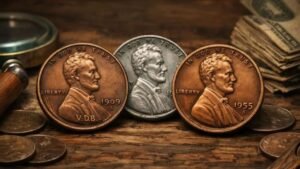
Struck by the United States Mint, the series circulated through two World Wars, the Great Depression, and postwar industrial expansion. Today, it stands as both a historical artifact and a gateway into serious coin collecting.
What Makes a Wheat Penny Worth $50,000?
Most Wheat Pennies are worth only a few cents to a few dollars. Reaching a $50,000 valuation requires a rare combination of scarcity, demand, and preservation.
Rare Mint Errors
Mint errors often command the strongest premiums because they represent unintended anomalies in the production process.
Among the most notable:
1943 Bronze Cent
During World War II, copper was reserved for military use, and pennies were struck in zinc-coated steel. A small number of leftover bronze planchets were mistakenly used in 1943. Authentic examples have reached well into six figures, with certain mid-grade pieces approaching the $50,000 range.
1944 Steel Cent
When copper returned in 1944, a few steel planchets from 1943 were accidentally struck. These transitional errors remain highly valuable.
1955 Doubled Die Obverse
A dramatic misalignment during die creation produced bold doubling in the date and lettering. Strong Mint State examples can achieve five-figure prices, depending on color and grade.
Key Low-Mintage Dates
Certain date-and-mint combinations are foundational to the series and carry long-standing collector demand.
Among the most significant:
1909-S VDB
1914-D
1931-S
In circulated condition, these coins can be worth hundreds or thousands of dollars. In pristine Mint State Red grades, select examples have approached or exceeded the $50,000 threshold.
Elite Condition
Condition is often the single greatest multiplier of value.
A coin graded Mint State (MS) with full original luster, sharp strike, and minimal contact marks may sell for exponentially more than the same coin in circulated condition.
Color designation also matters. Copper coins are graded as:
Red (RD) – Full original color
Red-Brown (RB) – Partial original luster
Brown (BN) – Fully toned
A key date in Red can be worth multiples of its Brown counterpart.
Professional authentication from respected grading firms such as Professional Coin Grading Service and Numismatic Guaranty Company is essential for achieving top-tier market prices. Certification provides standardized grading, authenticity assurance, and liquidity in high-value transactions.
How Rare Is a $50K Penny in Circulation?
Extremely rare.
While Wheat Pennies occasionally appear in inherited collections or old coin jars, the odds of discovering a genuine $50,000 example in daily change are minimal.
However, history shows that meaningful discoveries do occur. Several rare 1943 bronze cents were found decades after their production, often sitting unnoticed in private holdings.
The possibility—however remote—continues to inspire collectors to examine every Wheat Penny carefully.
How to Evaluate a Wheat Penny
If you find a Wheat Penny, approach it methodically.
1. Check the Date
Pay special attention to 1909, 1914, 1922, 1931, 1943, 1944, and 1955.
2. Identify the Mint Mark
Located below the date on the obverse:
D indicates Denver
S indicates San Francisco
No mint mark generally means Philadelphia
Certain mint and date combinations dramatically influence rarity.
3. Inspect for Errors
Using magnification, examine for:
Visible doubling in letters or numbers
Off-center strikes
Unusual metal composition or coloration
For 1943 cents, use a magnet. Steel cents will stick. A non-magnetic 1943 coin warrants professional evaluation.
4. Preserve Properly
Never clean a coin. Cleaning removes original surfaces and can permanently reduce value.
Handle only by the edges and store in non-PVC protective holders to prevent environmental damage.
Why Market Demand Remains Strong
Coin values are driven by verified scarcity and competitive demand. When multiple advanced collectors pursue the same high-grade rarity, prices escalate quickly.
High-profile auctions frequently feature elite Wheat Pennies with exceptional preservation and documented provenance. These represent the upper tier of the market—not everyday examples.
At the same time, online platforms have broadened global access, increasing visibility and competition for premium coins.
More Than Monetary Value
Beyond financial considerations, Wheat Pennies carry historical resonance.
A 1914-D cent circulated during America’s industrial rise. A 1943 steel cent reflects wartime material conservation. Each coin represents a tangible connection to economic decisions and manufacturing realities of its era.
Collectors value:
Historical narrative
Artistic design
Industrial evolution
The thrill of discovery
Few collectibles blend cultural depth and investment potential so seamlessly.
Final Perspective
A Lincoln Wheat Penny worth $50,000 is rare—but entirely possible under the right conditions. Exceptional key dates, dramatic mint errors, and pristine examples have achieved remarkable results in the collector marketplace.
For most, Wheat Pennies remain affordable pieces of history. For a fortunate few, however, a small copper coin has become a meaningful financial asset.
The next time you sort through spare change or an inherited collection, pause before dismissing that old penny. Within Lincoln’s familiar profile may lie a century-old story—and, in extraordinary cases, substantial value.