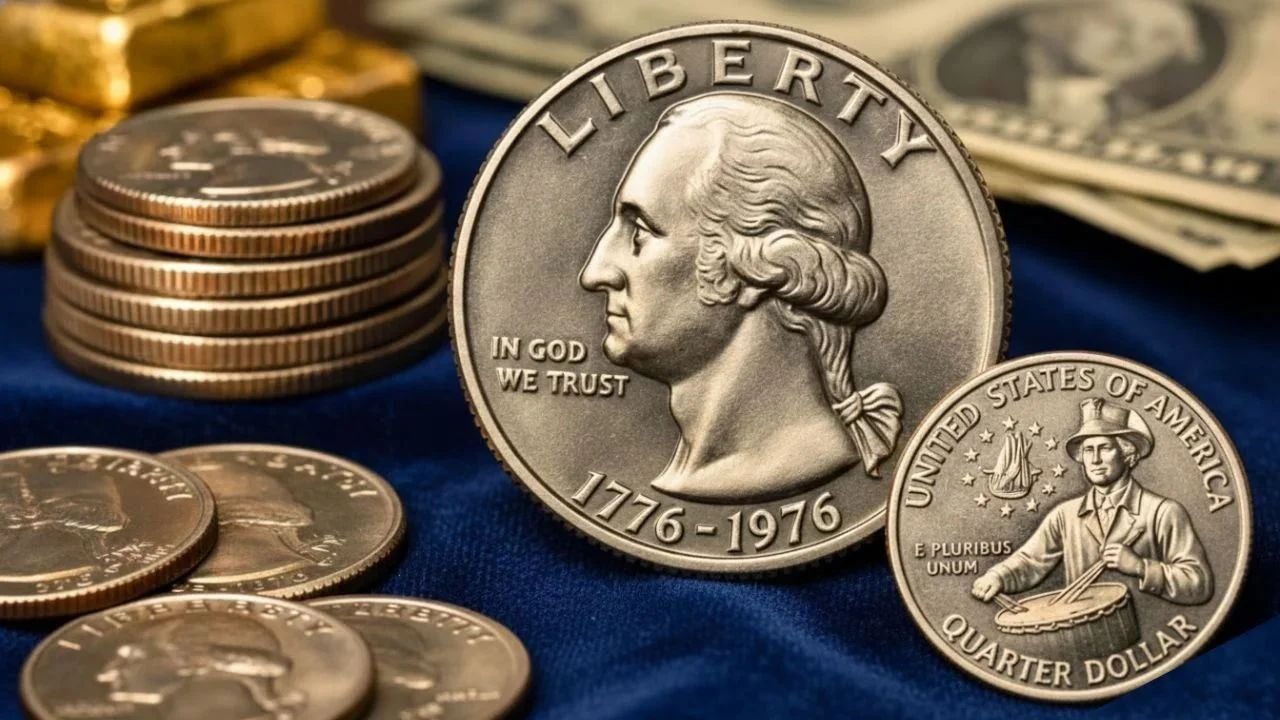
The 1776–1976 Bicentennial Quarter remains one of the most recognizable coins in modern American history. With its dual date and distinctive colonial drummer reverse, it stands apart from standard Washington quarters. Issued to commemorate 200 years of American independence, it blends patriotic symbolism with mass production scale.
In 2026, interest in Bicentennial Quarters continues to hold steady. While most examples remain worth face value, select silver editions, top-grade certified coins, and rare mint errors have achieved meaningful premiums. Understanding the difference between a common piece and a collectible standout is essential for today’s informed collector.
The Historical Significance Behind the Design

The Bicentennial Quarter was produced by the United States Mint in 1975 and 1976 to honor the 200th anniversary of the United States Declaration of Independence.
Unlike traditional quarters bearing a single year, these coins display the dual date “1776–1976” beneath the familiar portrait of George Washington on the obverse.
The reverse design, created by Jack L. Ahr, features a colonial drummer boy with a torch encircled by 13 stars, symbolizing the original colonies.
Notably, no quarters were dated 1975. All pieces struck during 1975 and 1976 carry the Bicentennial dual date.
Are Bicentennial Quarters Rare?
More than 1.6 billion Bicentennial Quarters were produced for circulation. That substantial mintage ensures that most examples found in pocket change are common and worth only 25 cents.
However, rarity is not determined by mintage alone. In numismatics, value depends on three critical variables:
Composition
Condition
Mint errors or special varieties
When one or more of these factors align at a high level, premiums can rise sharply.
The 40% Silver Bicentennial Quarter
In addition to standard copper-nickel clad coins, the Mint struck special 40% silver versions for collectors. These were not released into general circulation but were sold in commemorative proof and uncirculated sets, primarily from the San Francisco Mint.
How to Identify a Silver Example
Check the edge. Silver coins have a solid silver-colored edge with no visible copper stripe.
Confirm the mint mark. Most silver versions carry an “S” mint mark.
Weigh the coin. Silver pieces weigh slightly more than standard clad quarters.
Even circulated silver examples carry intrinsic melt value based on silver prices. In uncirculated or proof condition, typical market values range from $10 to $30, with higher premiums for exceptional preservation.
Rare Errors That Increase Value
Where meaningful upside exists is in authenticated mint errors. Though uncommon, certain production mistakes can elevate a Bicentennial Quarter well beyond face value.
Doubled Die Errors
A doubled die occurs when the working die receives multiple impressions during manufacturing, creating distinct duplication in design elements.
Examine closely:
The dual date
“LIBERTY”
“IN GOD WE TRUST”
Reverse lettering
True doubled die examples show clear separation rather than minor mechanical blur. Depending on clarity and condition, these can sell for hundreds or even thousands of dollars.
Off-Center Strikes
Off-center strikes occur when the planchet is misaligned during the striking process. The result is a partially missing design with blank metal space on one side.
Value typically increases with the percentage of off-center strike, provided the date remains visible.
Wrong Planchet Errors
Among the rarest and most desirable varieties are wrong planchet strikes. This occurs when a Bicentennial Quarter is struck on a blank intended for another denomination, such as a dime.
These pieces often differ in weight, diameter, and thickness. Authenticated examples can command several thousand dollars depending on condition and visual appeal.
Why Condition Drives Premium Value
Condition is the single most important factor for non-error Bicentennial Quarters.
Coins are graded on a 70-point scale. A coin graded MS65 or higher — with strong luster, minimal contact marks, and crisp strike detail — can command significant premiums over lower-grade examples.
Registry-quality coins, particularly those graded at the highest certified levels, sometimes reach hundreds or even thousands of dollars at auction due to collector competition.
Proof versions struck with specially prepared dies also command premiums when preserved in flawless condition.
Market Trends in 2026
In today’s market, the Bicentennial Quarter remains attractive for three primary reasons:
Historic symbolism
Iconic and instantly recognizable design
Entry-level accessibility for new collectors
While standard circulated pieces remain abundant, high-grade certified examples and authenticated error coins continue to attract steady demand.
Additionally, the silver editions offer a dual appeal — collectible value combined with tangible precious metal content. In an era where many investors seek hard assets, this hybrid appeal strengthens long-term interest.
Quick Identification Checklist
If you encounter a 1776–1976 quarter, consider the following:
Does the edge lack a copper stripe?
Is there strong, original mint luster?
Are there signs of clear doubling?
Is the strike off-center or otherwise unusual?
Is there an “S” mint mark?
If any answer is yes, professional evaluation may be worthwhile.
Frequently Asked Questions
Is every Bicentennial Quarter valuable?
No. Most are common and worth face value. Premiums apply primarily to silver versions, top-grade specimens, and verified mint errors.
Were any quarters dated 1975?
No. All quarters struck during 1975 and 1976 display the dual date “1776–1976.”
Should I clean a Bicentennial Quarter before selling it?
Never. Cleaning damages the coin’s surface and significantly reduces collector value. Original surfaces are always preferred.
Where should valuable examples be sold?
Certified coins typically achieve the strongest prices through established coin dealers, major auction houses, or reputable numismatic marketplaces.
Final Perspective
The 1776–1976 Bicentennial Quarter represents a defining moment in modern American coinage. It celebrates independence while serving as a gateway for generations of collectors entering the hobby.
Although most examples remain worth only 25 cents, silver editions, pristine mint-state coins, and authenticated error varieties continue to command attention in 2026.
Before spending your next Bicentennial Quarter, pause for a closer look. In rare cases, a coin that appears ordinary may hold both historical resonance and unexpected financial value.